Design thinking of creative solutions to the issues of education we do not know exist. Reflecting upon this it is a core ideal within geography to use maps (where possible). The promise of GIS in the classroom is the creation of new geographic thinking from the students (Fargher 2017).
Briggs (2022) wrote an article on design mapping. It ran through some of the history of maps, their abilities. Maps are wonderful, they transfer information without the need for language. They are both simple and complex at the same time; at least they are to me.
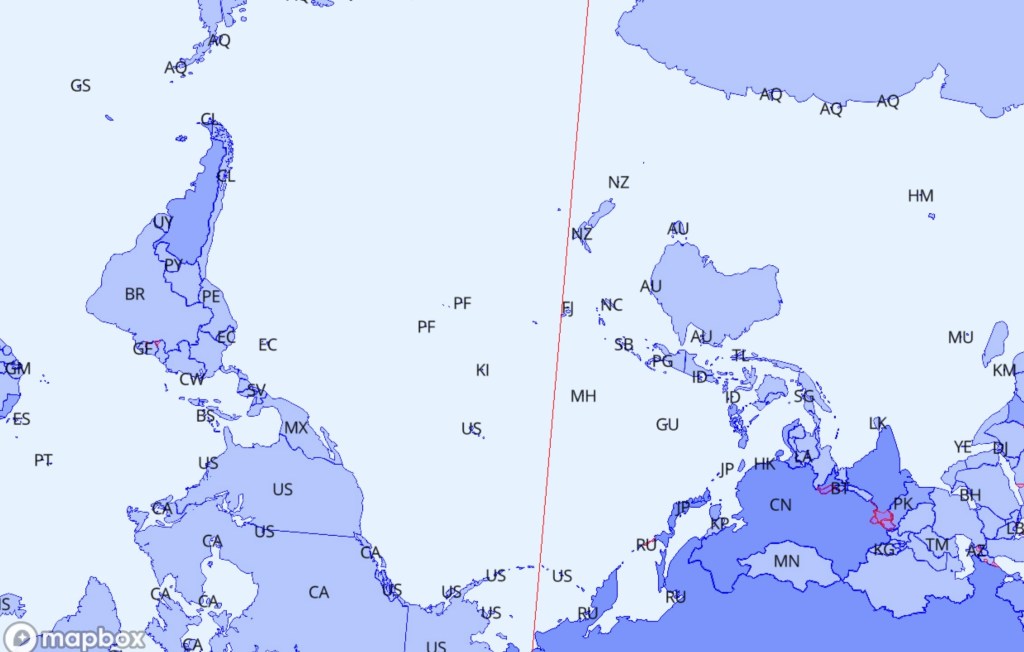
Fargher (2017) teaching GIS within a school can transform the concept of spatial thinking. This figure illustrates this as an idea. We are conditioned to ‘see’ maps in a particular way. The ‘upside down’ view of Earth seen in this figure is not complex for G.I.S.; it starts a journey in which G.I.S. can create an environment within the classroom for critical thinking by students.
Hodaz et al (2021) focuses on the design of the classroom learning with GIS. It is limited to the ability of the teacher. Hodaz et al (2021) with the lack of G.I.S. product knowledge highlights the failure within the geography teachers TPACK framework.
Briggs (2022) represents optimism, through the wonder of mapping. Fargher (2017) creates a vision and opportunity of geography from student engagement. The combination of these two ideas leads into the design thinking Bower (2017) spoke of solutions of issues unknown at the start of the process.
Bower, M. (2017). Design of technology-enhanced learning: integrating research and practice. In Design of technology-enhanced learning: integrating research and practice (First edition.). Bingley, UK: Emerald Publishing.
Briggs, C., (2022), The power of mapping. Interaction Design Foundation https://www.interaction-design.org/literature/article/the-power-of-mapping
Fargher, M., (2017), Chapter 11 GIS and the power of Geographical Thinking. Brooks, C., Butt, G., & Fargher, M. (2017). In The Power of Geographical Thinking. Springer International Publishing AG. https://doi.org/10.1007/978-3-319-49986-4_14
Hodza, P., Berendsen, M. E., & Hamerlinck, J. D. (2021). Towards a holistic framework for delivering quality GIS education within and across disciplines. Transactions in GIS, 25(4), 2146–2167. https://doi.org/10.1111/tgis.12773
Briggs (2022) wrote an article on design in mapping. It ran through some of the history of maps, some of the abilities. Maps are wonderful, they transfer information without the need for language. They are simple and complex at the same time.
 Technology Savior or Terminator?