Can A.I. have the capacity to answer complex assessments as set within the Australian curriculum? The criticism of A.I from Tampo (Tampo et al 2023) is it lacks critical thinking and inhibit students’ ability to learn this skill. Bearman and Ajjawi (2023) suggest a pedagogical approach is to compare an A.I. response to a quality piece of work. I have run a question through ChatGPT ‘In 1200 words to what extent was Hitler responsible for World War 2?’ to compare it to an above standard work sample on the Australian Curriculum Assessment and Reporting Authority web site.
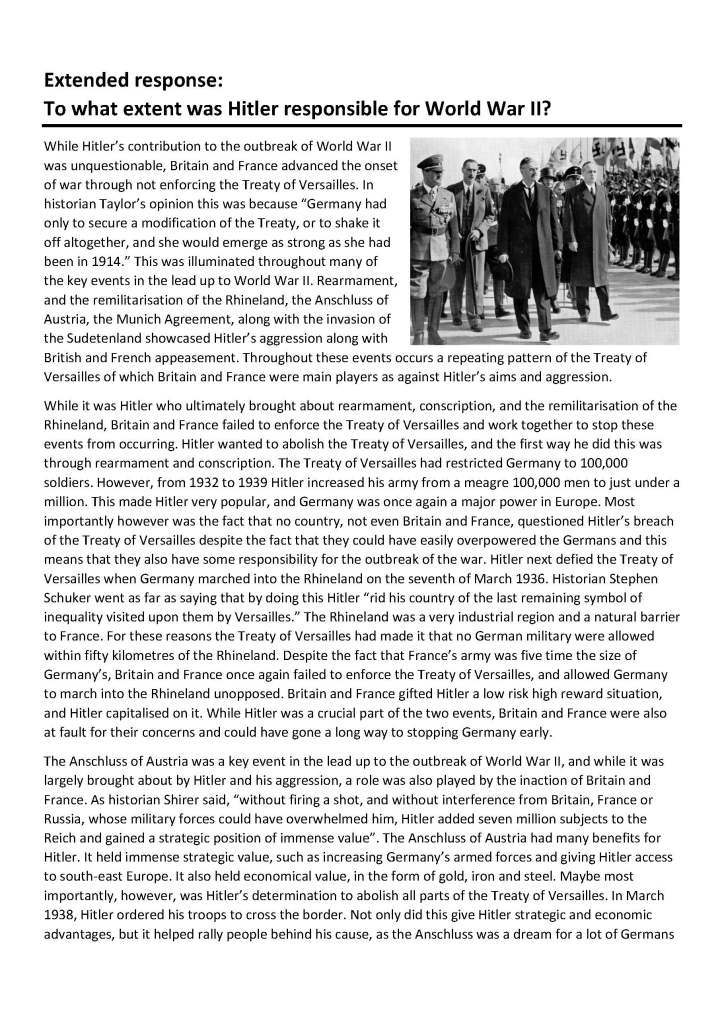
I then marked the ChatGPT work at a stage 5 level. It failed; it has a lot of content knowledge in the essay. However, it fails to address the question, “to what extent” the essay has no comparison at all. The student should be able to show cause and effect of the historical event. This just lists the events; it gives no background. It does not indicate the results of his actions. The PDF is the ChatGPT with some of my comments in red.
In the context of teaching history, the response given by ChatGPT, is a failure. Liu et al (2023) suggest A.I. can be used to scaffold a student’s assessment, currently it will not give an answer. As this has shown.
Bearman, M., & Ajjawi, R. (2023). Learning to work with the black box: Pedagogy for a world with artificial intelligence. British Journal of Educational Technology, 54(5), 1160–1173. https://doi.org/10.1111/bjet.13337
Liu, D., Bridgeman, A., and Miller, B., (2023) As uni goes back, here’s how teachers and students can use ChatGPT to save time and improve learning, The Conversation February 28, 2023
Tampo, N., Ali, A., Young, P. A., and Thekdi, S., (2023) Should AI be permitted in college classrooms? 4 scholars weigh in, The Conversation September 4, 2023
 Technology Savior or Terminator?